


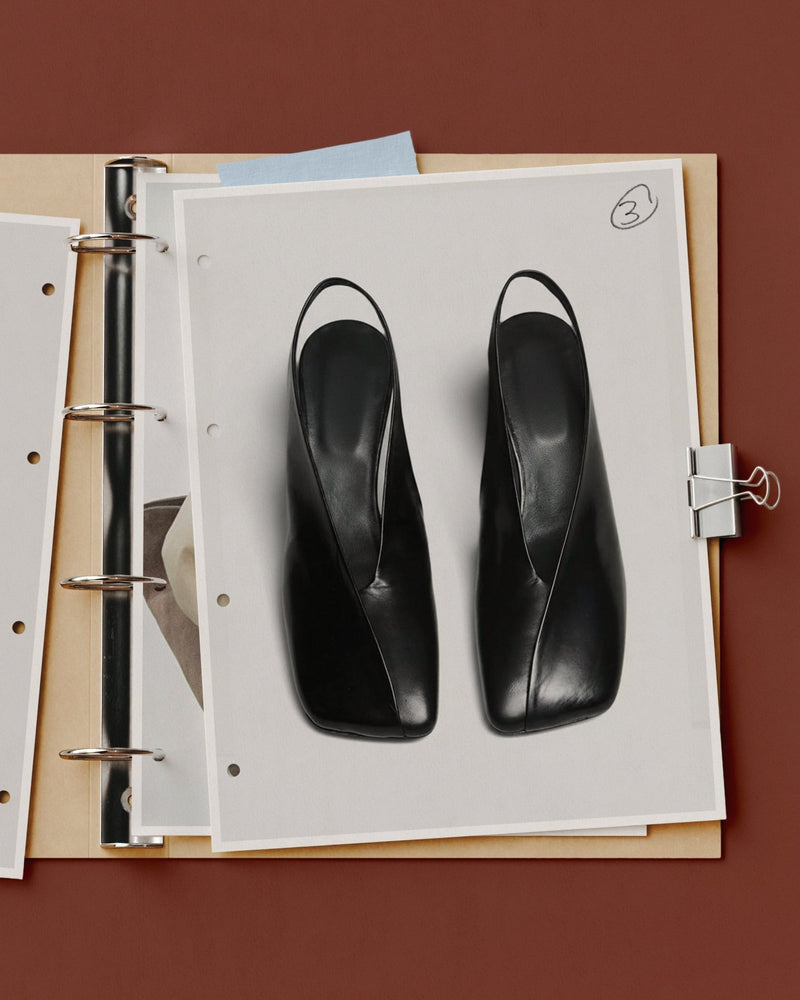

In April 2026, Shanghai hosts the first of four exhibitions drawn from Maison Margiela's internal file system — a Dropbox, made public, organised not by season or collection but by house code.
The materials on view are not those of a retrospective. They are binder rings holding Kodak contact strips, handwritten labels on manila tabs, tape-adhered photographs of fittings and garments in various states of assembly. Press releases drafted and re-drafted. Image timelines annotated in pen. The kind of documents that live inside project folders — the ones that remain on a shared drive after the campaign has run and the show has closed.
Artisanal opens in Shanghai from 2 to 6 April. Anonymity follows in Beijing. Tabi in Chengdu. Bianchetto in Shenzhen. Four house codes. Four cities. New files are added as the project evolves, which means the archive has no fixed state — it is not yet an archive, or it has decided that archives need not be finished.
The folder is open. What is inside looks a great deal like work.
Margiela is not the first house to surface its working materials, though it may be the first to present them without the architecture of a museum.
The most significant precedent belongs to Virgil Abloh. His reader — a publicly accessible site maintained throughout his career at reader.virgilabloh.com — was not a portfolio and was never described as one. It was closer to a filing system: research materials, reference images, half-formed ideas arranged and rearranged without the expectation that anyone would treat them as definitive. The folders were never curated for an audience. They were simply left open. After his death in 2021, the reader became something else — a document of creative process that functions, in retrospect, as a form of authorship in itself. The unfinished nature of the archive is what makes it legible as a body of work.
Other houses have made adjacent moves. Chanel has deposited archive pieces at the Palais Galliera in Paris. The MoMu in Antwerp mounted a major Margiela retrospective. But those gestures operate within the institution of the museum, where working materials become artefacts — labelled, lit, explained. The Abloh reader and the Margiela /folders are something different. They are live. They are searchable. They do not explain themselves. They present the work before it becomes definitive, in the period when it is still being handled, annotated, reconsidered.
What has accumulated, across these examples, is not a trend. It is a quiet shift in what fashion considers a publishable document.
Traditional fashion archives exist to validate legacy. A garment is conserved because it endured. A sketch is displayed because the collection it informed was consequential. The logic moves backwards from outcome to origin.
What the open folder does is different. It validates process.
The binder clip holding a stack of contact sheets is not incidental. It is a signature — evidence that someone gathered these images, sorted them, held them together with the nearest object to hand. The tape edge visible in a photograph is not a flaw in the reproduction; it is proof of handling, of time, of the number of occasions on which someone picked it up and put it down again. The Kodak frame border means the image was made on film, which carries a specific claim: that it was produced with a certain kind of attention, at a certain speed, with a finite number of exposures. These are not aesthetic choices. They are epistemological ones. They say: this came from somewhere real.
There is a quiet consequence to this. When the working document becomes the primary document — when the filed folder is the exhibition, not the preparation for one — the relationship between process and product reverses. The most interesting object in the room is no longer the finished garment. It is the photograph of the garment pinned to a wall, with a pencil note in the margin that nobody was meant to read.
The same language — archival paper, punched binder pages held with silver clips, handwritten labels on tabbed dividers, the physical texture of records kept by hand — runs through October November's Fashion Journal Mockups, published through Studio Standard.
The mockups work within the register that Margiela has just made explicit. Manila folders. Translucent paper overlays. Masking tape securing photographs to pages that show subtle fold marks from use. The material choices are not imitations of a visual trend; they are the working vocabulary of houses and studios that have maintained this kind of documentation for decades. What is recent is not the language itself but the decision to make it visible.
Browsing them recalls the experience of pausing on a folder in the Margiela Dropbox — recognising the paper weight, the clip placement, the particular way a label has been handwritten and adhered. The recognition is not of a brand. It is of a practice.
Fifteen years of interface culture optimised for the opposite of this. Polished surfaces. Transactions without friction. Design that asks to be used, not examined. The edge was smoothed, the label removed, the folder replaced by something that does not resemble a folder at all.
What fashion is doing now — deliberately, and across enough houses to constitute something more than a gesture — is returning to the legible object. The folder with its label. The page with its tape. The binder ring that shows, by its wear, how many times the pages have been turned.
The archive does not pretend to be finished. That may be the point. Or it may simply be the condition under which the most careful work has always been kept — filed, not framed, waiting for someone to open it again.


